
Prescribe SPIRIVA RESPIMAT 2.5mcg at diagnosis

Start a LAMA, like SPIRIVA RESPIMAT, for your patients with mild COPD1,2
Tiotropium contributes to ameliorating the annual decline of FEV11-3*
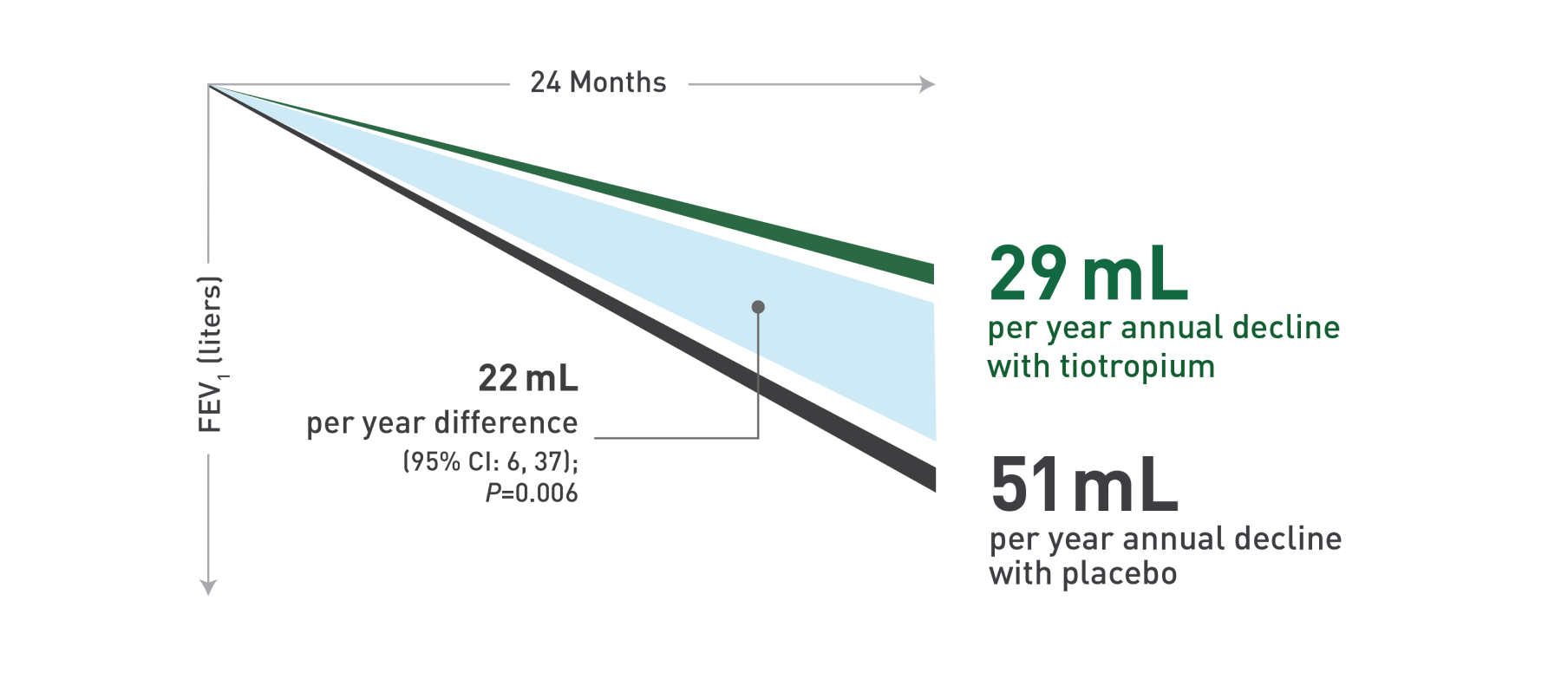
From day 30 through month 24, annual FEV1 decline in patients taking tiotropium 18 mcg† was 29 mL per year vs 51 mL for placebo—a significant difference of 22 mL per year.
While only smoking cessation is proven to slow the progression of COPD, data suggest that starting tiotropium early is associated with benefits in disease progression.1,2,4,5
FEV1, forced expiratory volume in 1 second; CI, confidence interval; GOLD, Global Initiative for Chronic Obstructive Lung Disease.
-
*
After bronchodilator use in patients with GOLD stage 1 or 2 COPD
-
†
This study was conducted using SPIRIVA® HANDIHALER® (tiotropium bromide inhalation powder).
STUDY DESIGN
In a 2-year, multicenter, randomized, double-blind, placebo-controlled trial that was conducted in China, 841 patients with COPD of GOLD stage 1 (mild) or 2 (moderate) severity were evaluated to compare tiotropium—the active ingredient in SPIRIVA RESPIMAT—and placebo on the primary endpoint: the between-group difference in the change from baseline to 24 months in FEV1 before bronchodilator use. Secondary endpoints included: the between-group difference in the change from baseline to 24 months in FEV1 after bronchodilator use; FVC before and after bronchodilator use at 24 months from baseline; annual declines in FEV1, FEV1 as a percentage of the predicted value before and after bronchodilator use, and the FEV1:FVC ratio from Day 30 through Month 24; changes in COPD Assessment Test (CAT) score, Clinical COPD Questionnaire (CCQ) score, and modified Medical Research Council (mMRC) dyspnea scale score from baseline to 24 months; duration and severity of COPD exacerbations; time to first COPD exacerbation; and use of rescue medications. The key inclusion criteria were being aged 40-85 years and having a diagnosis of COPD of GOLD stage 1 or 2, defined as an FEV1:FVC ratio <0.70 after bronchodilator use plus respiratory symptoms, a history of exposure to risk factors (eg, smoking, air pollution, biomass combustion), or both, and an FEV1 of ≥50% of the predicted value, measured 20 minutes after the inhalation of 400 μg of albuterol.1
FEV1, forced expiratory volume in 1 second; GOLD, Global Initiative for Chronic Obstructive Lung Disease; FVC, forced vital capacity.
Initiating SPIRIVA RESPIMAT early improves lung function3,6
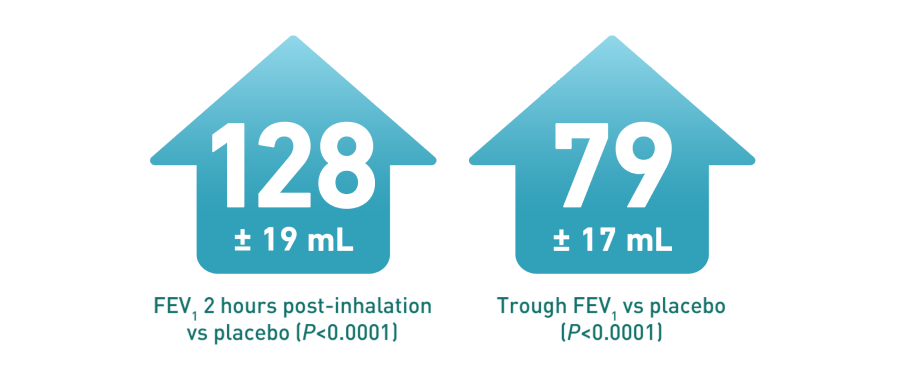
After 12 weeks, tiotropium 18 mcg‡ produced significant increases in both trough FEV1 (23-24 hours after the last inhalation of the study medication) and FEV1 2 hours post-inhalation, compared with placebo. Trough FEV1 values increased by an average of 79 ± 17 mL vs placebo (P<0.0001). At 2 hours post-inhalation FEV1 increased by 128 ± 19 mL vs placebo (P<0.0001).
FEV1, forced expiratory volume in 1 second.
-
‡
This study was conducted using SPIRIVA® HANDIHALER® (tiotropium bromide inhalation powder).
STUDY DESIGN
In a 12-week, randomized, double-blind, placebo-controlled study, 1838 patients with COPD of different severities were evaluated to compare tiotropium—the active ingredient in SPIRIVA RESPIMAT—and placebo (3:1) on primary endpoints: initial morning (trough) FEV1 value 23-24 hours after the preceding inhalation of the study medication and the FEV1 2 hours after inhalation. The reduction in COPD exacerbations was also investigated. Patients were required to have stable COPD with FEV1 70% of the predicted value and an FEV1/FVC ratio of <0.7. Additionally, they were required to have a smoking history of ≥10 pack-years and be ≥40 years of age. Patients were uniformly distributed over 3 levels of severity according to the classification recommended by the American Thoracic Society: severe (FEV1 <35% of predicted), 439 patients; moderate (FEV1 35–<50% of predicted), 586 patients; mild (50–70% of predicted), 530 patients (81 patients with an FEV1 >70% of predicted were evaluated separately as patients with very mild COPD).8
FEV1, forced expiratory volume in 1 second; FVC, forced vital capacity.
Help your patients with COPD reduce the use of rescue inhalers1,7
Your patients may be using a rescue inhaler more than you think.
With SPIRIVA RESPIMAT 2.5mcg, patients may rely on their rescue inhalers less.
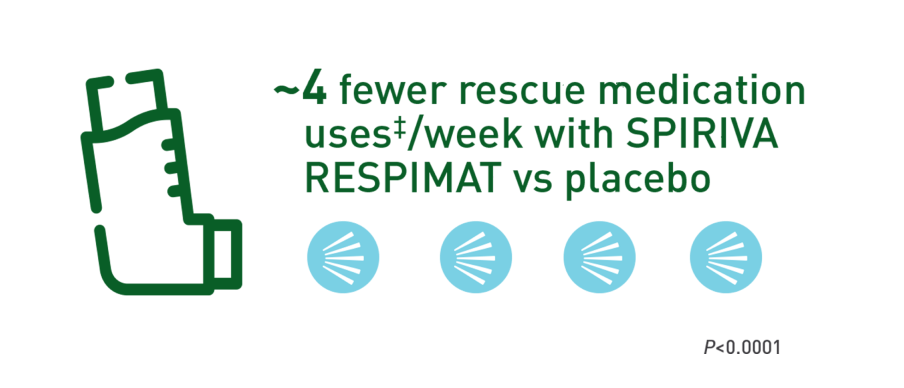
In a study of 1990 patients with COPD, patients had ~4 fewer rescue medication uses§ per week with SPIRIVA RESPIMAT vs placebo.
-
§
Rescue medication use was defined as “occasions per day.” In this study, the difference in occasions per day between SPIRIVA RESPIMAT 5mcg and placebo was -0.6.
STUDY DESIGN
In 2 identical, 1-year, multicenter, multinational, randomized, double-blind, parallel-group studies, a combined total of 1990 patients with COPD were evaluated to compare SPIRIVA RESPIMAT 5 or 10 μg and placebo on 4 coprimary endpoints: trough FEV1 response at week 48 (24-hour post-dose FEV1 expressed as change from study baseline pre-dose FEV1); St George’s Respiratory Questionnaire (SGRQ) total score at the end of the 48-week treatment period; the Mahler Transition Dyspnea Index (TDI) focal score after 48 weeks of treatment; and COPD exacerbations per patient-year defined as respiratory adverse events lasting ≥3 days and requiring treatment with antibiotics and/or oral corticosteroids and/or a significant change in prescribed respiratory medication including inhaled bronchodilators. Secondary endpoints included FVC, peak expiratory flow rate (PEFR) (measured using a mechanical meter) and weekly mean number of occasions (per day as needed) that rescue medication was used. Patients were aged ≥40 years with a diagnosis of COPD and stable, moderate-to-severe airway obstruction (prebronchodilator FEV1 ≤60% predicted and FEV1 ≤70% of FVC), and with a smoking history of ≥10 pack-years.9
FEV1, forced expiratory volume in 1 second; FVC, forced vital capacity.
SPIRIVA RESPIMAT, 2.5mcg, is indicated for the long-term, once-daily, maintenance treatment of bronchospasm associated with chronic obstructive pulmonary disease (COPD), including chronic bronchitis and emphysema, and for reducing COPD exacerbations.
SPIRIVA RESPIMAT, 1.25mcg, is a bronchodilator indicated for the long-term, once-daily, maintenance treatment of asthma in patients 6 years of age and older.
SPIRIVA RESPIMAT is not indicated for relief of acute bronchospasm.
SPIRIVA® RESPIMAT® (tiotropium bromide) Inhalation Spray is contraindicated in patients with a hypersensitivity to tiotropium, ipratropium, or any component of this product. Immediate hypersensitivity reactions, including angioedema (including swelling of the lips, tongue, or throat), itching, or rash have been reported.
SPIRIVA RESPIMAT is intended as a once-daily maintenance treatment for COPD and asthma, and should not be used for the relief of acute symptoms, i.e., as rescue therapy for the treatment of acute episodes of bronchospasm. In the event of an attack, a rapid-acting beta2-agonist should be used.
Immediate hypersensitivity reactions, including urticaria, angioedema (including swelling of the lips, tongue, or throat), rash, bronchospasm, anaphylaxis, or itching may occur after administration of SPIRIVA RESPIMAT. If such a reaction occurs, discontinue SPIRIVA RESPIMAT at once and consider alternative treatments. Given the similar structural formula of atropine to tiotropium, patients with a history of hypersensitivity reactions to atropine or its derivatives should be closely monitored for similar hypersensitivity reactions to SPIRIVA RESPIMAT.
Inhaled medicines, including SPIRIVA RESPIMAT, may cause paradoxical bronchospasm. If this occurs, it should be treated with an inhaled short-acting beta2-agonist, such as albuterol. Treatment with SPIRIVA RESPIMAT should be stopped and other treatments considered.
SPIRIVA RESPIMAT should be used with caution in patients with narrow-angle glaucoma. Prescribers and patients should be alert for signs and symptoms of acute narrow-angle glaucoma (e.g., eye pain or discomfort, blurred vision, visual halos or colored images in association with red eyes from conjunctival congestion and corneal edema). Instruct patients to consult a physician immediately should any of these signs or symptoms develop.
Since dizziness and blurred vision may occur with the use of SPIRIVA RESPIMAT, caution patients about engaging in activities such as driving a vehicle, or operating appliances or machinery.
SPIRIVA RESPIMAT should be used with caution in patients with urinary retention. Prescribers and patients should be alert for signs and symptoms of urinary retention (e.g., difficulty passing urine, painful urination), especially in patients with prostatic hyperplasia or bladder-neck obstruction. Instruct patients to consult a physician immediately should any of these signs or symptoms develop.
Patients with moderate to severe renal impairment (creatinine clearance of <60 mL/min) treated with SPIRIVA RESPIMAT should be monitored closely for anticholinergic side effects.
The most common adverse reactions >3% incidence and higher than placebo with SPIRIVA RESPIMAT (placebo) in COPD trials were pharyngitis 11.5% (10.1%), cough 5.8% (5.5%), dry mouth 4.1% (1.6%), and sinusitis 3.1% (2.7%).
The most common adverse reactions >2% incidence and higher than placebo with SPIRIVA RESPIMAT (placebo) in asthma trials in adults were pharyngitis 15.9% (12.4%), headache 3.8% (2.7%), bronchitis 3.3% (1.4%), and sinusitis 2.7% (1.4%). The adverse reaction profile for adolescent and pediatric patients was comparable to that observed in adult patients with asthma.
SPIRIVA RESPIMAT may interact additively with concomitantly used anticholinergic medications. Avoid administration of SPIRIVA RESPIMAT with other anticholinergic-containing drugs.
Inform patients not to spray SPIRIVA RESPIMAT into the eyes as this may cause blurring of vision and pupil dilation.
You are encouraged to report negative side effects of prescription drugs to the FDA. Visit www.FDA.gov/medwatch or call 1-800-FDA-1088.
CL-SVR-100065 2.15.2017
Please see full Prescribing Information, including Instructions for Use, for SPIRIVA RESPIMAT.
References
-
SPIRIVA RESPIMAT [prescribing information]. Ridgefield, CT: Boehringer Ingelheim Pharmaceuticals, Inc; January 2025.
-
Global Initiative for Chronic Obstructive Lung Disease (GOLD). Global strategy for the diagnosis, management, and prevention of chronic obstructive pulmonary disease. Accessed November 18, 2024. https://goldcopd.org/2025-gold-report/
-
Zhou Y, Zhong N, Li X, et al. Tiotropium in early-stage chronic obstructive pulmonary disease. N Engl J Med. 2017;377(10):923-935.
-
Troosters T, Celli B, Lystig T, et al; UPLIFT® investigators. Tiotropium as a first maintenance drug in COPD: secondary analysis of the UPLIFT® trial. Eur Respir J. 2010;36(1):65-73.
-
Scanlon PD et al. Smoking cessation and lung function in mild-to-moderate chronic obstructive pulmonary disease. Am J Respir Crit Care Med. 2000;161:381-90.
-
Morice Ah, Celli B, et al. COPD in young patients: A pre-specified analysis of the four-year trial of tiotropium(UPLIFT). Respir Med. 2010;104(11):1659-67.
-
Decramer M, Celli B, Kesten S, Lystig T, Mehra S, Tashkin DP; UPLIFT investigators. Effect of tiotropium on outcomes in patients with moderate chronic obstructive pulmonary disease (UPLIFT): a prespecified subgroup analysis of a randomised controlled trial. Lancet. 2009;374(9696):1171-8.
-
Beeh KM, Beier J, Buhl R, Stark-Lorenzen P, Gerken F, Metzdorf N; ATEMStudiengruppe. Efficacy of tiotropium bromide (SPIRIVA®) in patients with chronic obstructive pulmonary disease (COPD) of different severities. Pneumologie. 2006;60(6):341-6. [Translated from German.]
-
Bateman E, Singh D, Smith D, et al. Efficacy and safety of tioropium RESPIMAT® SMI in COPD in two 1-year randomized studies. Int J Chron Obstruct Pulmon Dis. 2010;5:197-208.